

Risky Bulletin Newsletter
June 12, 2026
Risky Bulletin: In the age of AI, CISA changes federal patching rules
Written by

News Editor
This newsletter is brought to you by SpecterOps, the experts in Attack Path Management. You can subscribe to an audio version of this newsletter as a podcast by searching for "Risky Business" in your podcatcher or subscribing via this RSS feed. You can also add the Risky Business newsletter as a Preferred Source to your Google search results by going here.
The US Cybersecurity and Infrastructure Security Agency (CISA) issued a new binding operational directive (BOD) this week that updates the patching rules for federal civilian agencies.
The new order cites the rise of AI-automated attacks as the main reason to prioritize bugs based on the risk they pose to federal networks and shorten patching deadlines.
The order introduces a new decision tree (pictured below) that will prioritize vulnerabilities that are exploited in the wild, are easy to exploit and automate, and grant broad access to a system if they have been exploited.
Under the new categorizations , the new patching deadlines can go down as three days.
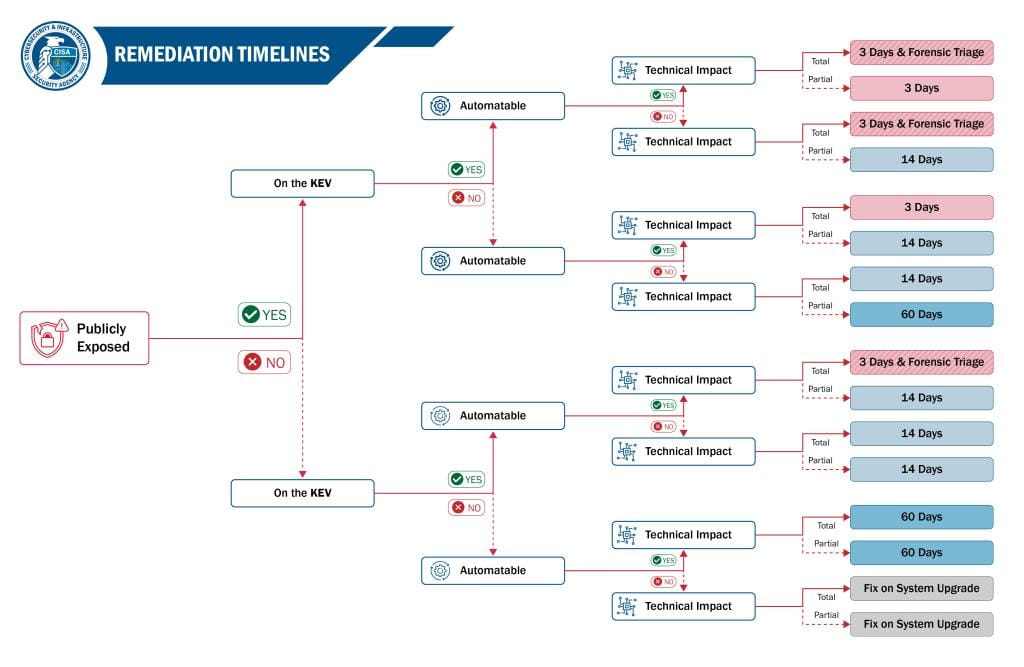
The order also gives federal agencies the ability to expand a bug's patching deadline if they take the system off the internet or disconnect it from their network until it can be updated.
CISA has already been applying these new rules for more than a month now. Eagle-eyed security researchers would have already noticed that recent entries on the CISA KEV (Known Exploited Vulnerabilities) database have had three-day patching deadlines for a while now.
The agency has also been teasing new patching rules in public statements for weeks as well, so the new BOD finally brings some predictable structure to what appeared to be chaotic messaging.
The change in patching rules comes at a tumultuous time for CISA, as the agency has been without a Director for more than a year, and after a funding lapse has ruined the NIST NVD vulnerability database, which has been swamped by new entries that have yet to be enriched.
The solution to fix NVD was to only enrich certain classes of bugs, such as bugs actively exploited in the wild and those in equipment and software used on US government networks.
The new CISA BOD follows this new broader strategy of only caring about bugs that directly impact US government networks, in what CISA calls a "patch smarter, not harder" strategy.
Risky Business Podcasts
The main Risky Business podcast is now on YouTube with video versions of our recent episodes. Below is our latest weekly show with Pat, Adam, and James at the helm!
Breaches, hacks, and security incidents
Argentina soccer squad passport leak: The passport details of Argentina' soccer squad were leaked ahead of the World Cup tournament. Passport details were left unredacted on an official team sheet that was circulated to the press on Tuesday before a pre-World Cup friendly game against Iceland. The World Cup kicked off on Thursday. [Sportstar]
Thailand health agency breach: Hackers have allegedly stolen the personal information of more than 67 million Thai citizens. The data was allegedly taken from a government agency that manages healthcare entitlements. The Thai government has launched a probe of the incident after some of the stolen data was posted on online black markets. [The Bangkok Post] [h/t DataBreaches.net]
Rep. Bacon hacked by Russia: Suspected Russian hackers have breached the Signal account of US Representative Don Bacon. The FBI notified the Nebraska Republican of the hack this week. Bacon is a staunch supporter of Ukraine and a known critic of the Kremlin. [Politico] [h/t Yuri A.]
University of Nottingham breach: More than 450,000 students and alumni of the University of Nottingham in the UK have had their data stolen in a hack this month. A hacking group known as ShinyHunters took credit for the hack. The group claims it stole more than 40GB of files from the university's Oracle PeopleSoft platform. [University of Nottingham // HIBP]
Coupang gets record fine: South Korea has fined American retailer Coupang $409 million (624.6 billion won) for a data breach last year that exposed the information of 34 million citizens. The fine represents around 1.7% of the company's 2025 sales. Companies in South Korea can be fined up to 3% of their annual sales for security and privacy violations. The breach was traced back to a Chinese software engineer who has since left the country. The company says it will appeal the fine. [PIPC // Yahoo Finance]
Hackers are extorting Jamaica: Hackers are extorting the Jamaican health ministry. Threat actor has contacted the National Health Fund seeking payment not to release stolen data. The government says it's still investigating if a breach indeed took place. [Caribbean National Weekly]
Cyberattack stops sugar mills: A major Australian sugar mill has paused operations following a cyberattack this week. Mackay Sugar has stopped cane haulage and milling at two sugar mills in the Mackay region. The cyberattack hit right at the start of the yearly sugarcane crushing season. The company is Australia's second-largest sugar producer. [ABC // Mackay Sugar]
Philippines Senate website defaced: A hacktivist group named Nullsec Philippines has defaced the website of the Philippines Senate. [The Filipino Times]
General tech and privacy
npm to block auto-run install scripts by default: Npm will block all auto-running installation scripts starting next month with the release of version 12.0. The change is meant to counter the rising number of supply-chain attacks taking place on the platform. Currently, threat actors are hiding malicious commands inside install scripts that get auto-executed when a victim installs a new package. [GitHub // OpenSourceMalware]
Python delays JIT feature: The Python steering committee has delayed the rollout of a new Just-In-Time compiler. [Python]
Google blocks MV2 extensions in Chrome: Chrome 150, to be released next month, will fully block extensions built on the old Manivest V2 platform, meaning the old uBlock Origin ad blocker will not work anymore. Opera will also block them. [Neowin // GitHub // Opera]
Firefox gives free VPN: Mozilla is giving away unlimited Firefox VPN traffic to all Firefox users until August 31. Free VPN users typically have a monthly bandwidth of only 50 GB. [Mozilla]
EU screams at Meta: The EU has ordered Meta to open WhatsApp to other AI agents and assistants after removing competitors from its messenger last year. [European Commission]
Meta wants to defer responsibility: Meta has urged lawmakers to abandon social media bans and instead force app store makers to verify the age of their users, aka Apple and Google. This blog post is no surprise. The company has been linked to secret backroom lobbying to move any age check operations from the social media platforms to app stores, and device and OS makers. It's anyone else's problem except Meta, the actual cesspit. [Meta]
Google Search Services History: Google has launched Search Services History, a new dashboard where users can view the search history across multiple Google services. [Google // The Verge]
Google joins Eclipse Foundation: Google has formally joined the Eclipse Foundation to specifically "accelerate" the integration of AI tech into its tools. Puke in mouth! [Google]
Government, politics, and policy
US Cyber Force voted out of NDAA: A proposal to set up a dedicated US Cyber Force military branch has been voted down in the Senate. The provision has been removed from the annual National Defense Authorization Act after a narrow 14-13 vote in the Senate Armed Services Committee. Lawmakers argued that Congress should wait for the results of a study by the National Academy of Sciences, Engineering, and Medicine (NASEM) on the merits of establishing a separate cyber branch before enacting it into law. [The Record]
FCC seeks stronger telco KYC: The US Federal Communications Commission is seeking to introduce strong Know-Your-Customer rules for American telcos. Wireless operators will have to collect extensive personal data on every new and old customer. The data will range from real names to government IDs and device details. The FCC says the new rule is needed to fight fraud and robocallers. Critics say the new requirement will also make it impossible to purchase anonymous phone numbers and run burner phones in the US. [Federal Register // 404 Media]
UK weakens proposed telecom rules: The UK government has weakened proposed cybersecurity rules for telecom operators after intense lobbying from the industry. The government proposed the rules in the aftermath of the Salt Typhoon hacks. According to The Record, telecoms argued the rules lacked practicality and introduced unnecessary costs. [The Record]
Poland criminalizes "trash streaming": Poland has introduced prison sentences of up to five years for the streaming of abusive materials. Known as "trash streaming," this includes animal cruelty,physical violence, rapes, murder, and acts that humiliate others. The law also applies for individuals who simulate the acts for online content. [Reuters]
Canada to ban social media for under 16s: The Canadian government has proposed a bill to ban children under the age of 16 from social media networks. Online platforms can receive exemptions if they can prove their platforms are safe. Canada is the latest in a very long list of countries that are passing social media restrictions for kids. [Government of Canada]
Sponsor section
In this Risky Business sponsor interview, James Wilson chats with SpecterOps CTO Jared Atkinson about the central role that GitHub has played in recent supply chain compromises. GitHub is where code gets built, tested, and shipped to devices, cloud, and on-prem environments. Understanding the paths an attacker can use to get into GitHub, and where they can pivot to from there, is essential to securing your GitHub repos and CI/CD pipelines.
Arrests, cybercrime, and threat intel
DOJ seizes Chinese recruitment sites: The FBI has seized 13 domains used by Chinese spies to recruit Americans with access to classified or sensitive data. The websites posed as fake consulting companies and think tanks. The sites offered to pay former American officials for sensitive information as consultancy fees. The website seizures come a week after intelligence agencies from the Five Eyes countries issued a joint warning on China's new tactics. [DOJ // Joint Five Eyes Alert]

Canadian hacker to be extradited to US: A Canadian court has approved the extradition of a Canadian man to the US to face hacking charges. Ryan James Roach allegedly hacked a New York educational institution in 2017 and deployed a crypto-miner on its supercomputer. The breach allegedly caused damages of $337,000. [CBC]
AudiA6 laundering service seized: Europol has seized a cryptocurrency mixer that was being used by ransomware groups to launder their profits. The AudiA6 service is suspected of laundering more than €336 million between 2022 and 2025. Two administrators were also arrested in the country of Georgia. They were identified as a Ukrainian and a Russian national. Authorities seized web domains, suspended Telegram accounts, and seized money and property. [Europol]

Ennetcom CEO gets a reduced sentence on appeal: A Dutch court of appeal has lowered the prison sentence of the CEO of crypto-phone maker Ennetcom. The court reduced his sentence from 54 months in prison to only 10. Authorities seized Ennetcom operations in 2016. The company sold closed-system encrypted BlackBerry phones, primarily to criminal groups. [Dutch Judiciary]
Stupid OpenClaw: Researchers put an OpenClaw agent through a phishing test and the silly clanker fell for all four, clicking links and entering personal data. On the other hand, Sophos gave OpenClaw a penetration testing toolkit and pointed it at one of its legacy AD networks and OpenClaw was a little bit smarter and hacked his way all over the place. [Varonis]
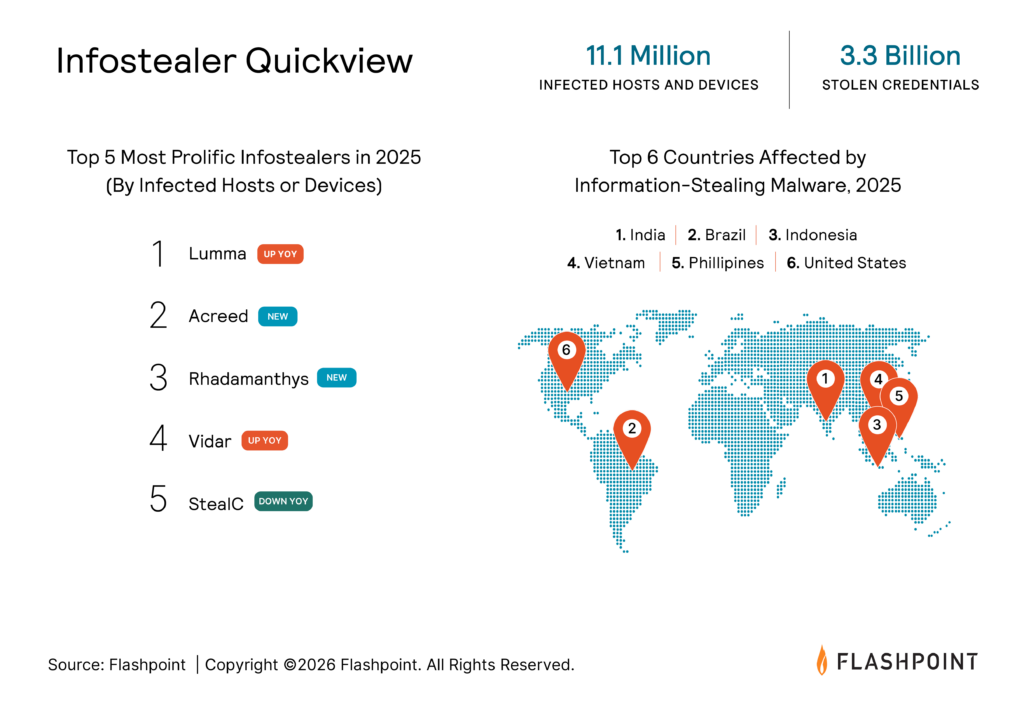
11 million infected with infostealers last year: More than 11.1 million users were infected with infostealers last year. The infostealers stole more than 3.3 billion credentials, cookies, and access tokens, most of which made their own on underground password shops. According to Flashpoint, the most common infection was with Lumma Stealer, an operation that was eventually targeted in a takedown attempt. [Flashpoint]
Galaxy brain phishing evasion: Sublime researchers have found a phishing campaign that used a pretty smart evasion tactic where the malicious payload was delivered and assembled using a dictionary of legitimate business terms. [Sublime Security]
Everest interview: Threat intelligence analyst Marco A. De Felice has published an interview with the operators of the Everest ransomware group. [SuspectFile]
Phantom Mantis profile: Researchers have put together a history of Phantom Mantis, a cybercrime group that has worked as an affiliate for several ransomware operations, such as LockBit, Qilin, and now The Gentlemen. The report was based on a recent leak of internal chats from The Gentlemen RaaS. [PRODAFT]
NinjaOne RMM abuse: Add NinjaOne to the list of Remote Monitoring and Management (RMM) agents that are being abused in the wild by cybercrime groups. This one was abused in a campaign targeting Brazilian companies. [Cato Networks // LOLRMM]
npm snafu: The npm security team has accidentally applied a security hold on a bunch of one-character npm packages. This has now been reverted. [Socket Security]
Supply chain attacks: Aikido Security, CyFirma, SafeDep.
Criminal AI-as-a-Service: Rapid7 looks at the growing underground market of cybercrime AI service providers, ranging from malware-writing tools to phishing lure writing aids. Some of these services are running on top of compromised legit services, while others run their own black market LLMs. [Rapid7]

Malware technical reports
GoFlateLoader: A new Go-based loader named GoFlateLoader has been used in several campaigns to deliver multiple infostealers, such as Amatera, Remus, Lumma, Vidar and StealC. [Gen Digital]
OnionDrop: Another loader commonly used these days to deliver a ton of infostealers is OnionDrop. [Cyderes]
Agent Tesla: There's a new malspam campaign spreading the good ol' Agent Tesla around. [Point Wild]
MTLBackdoor: A new backdoor has been spotted in the wild. The malware has been used as an initial entry point from where threat actors could move laterally and expand access to a network. The final payload in some intrusions was eventually ransomware. [Zscaler]
BlueRabbit: Researchers have spotted a new Iran-nexus all-in-one backdoor named BlueRabbit that can be used for remote access, system profiling, file encryption, and even disk wiping. [BinaryDefense]
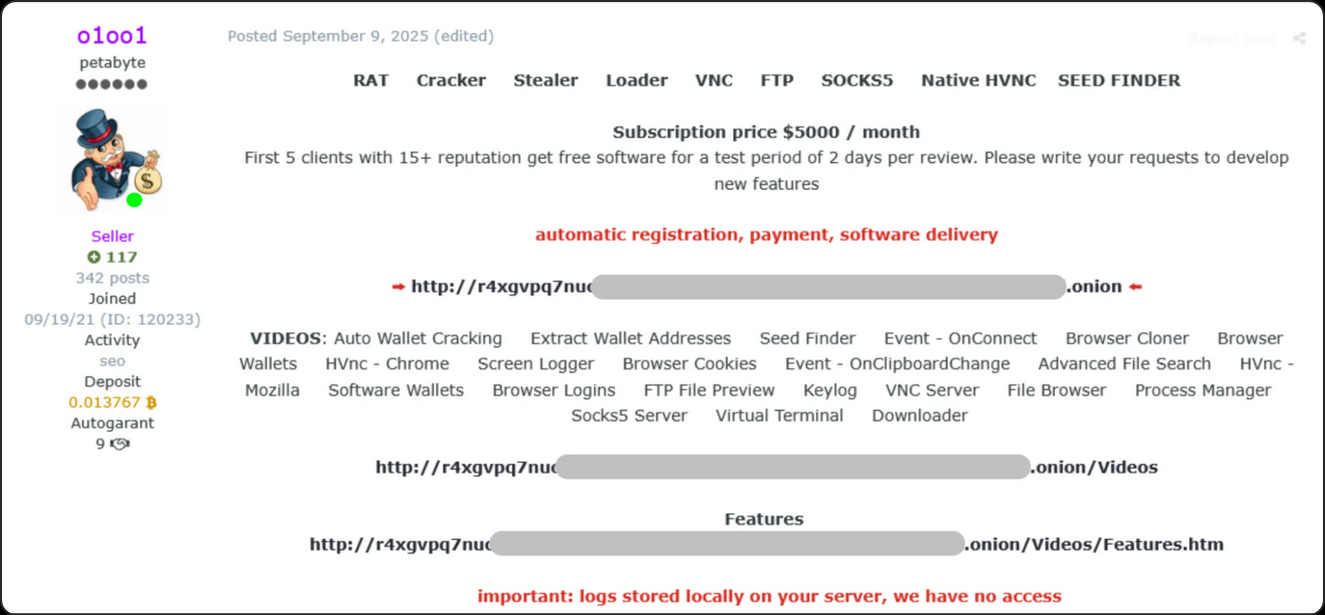
SilabRAT: There's a new remote access trojan being sold online under a MaaS model. Named SilabRAT, this one is sometimes detected by some engines as "Hijackloader." The thing that stands out here is the insane monthly price of $5,000. Yeah, good luck with that! [Group-IB]
Sponsor section
In this sponsored Soap Box edition of the show, Patrick Gray and James Wilson talk about red teaming AI systems with Russel Van Tuyl, Vice President of Services at elite penetration testing firm SpecterOps. SpecterOps is the company behind attack path enumeration tool Bloodhound and Bloodhound Enterprise, but they're also a pentest and red teaming shop with world class expertise in popping shells on all sorts of interesting systems in all sorts of interesting places.
APTs, cyber-espionage, and info-ops
Laundry Bear member extradited to US: A member of a Russian state-sponsored hacking group has been arraigned and charged in a US court this week. Denis Obrezko was arrested in Thailand in November last year. He is believed to be a member of the Void Blizzard APT, also known as Laundry Bear. He is accused of hacking US companies and harvesting their email inboxes. [Reuters]
APT28: Sekoia looks at the evolution of APT28 operations and their toolkits over the past two decades. [Sekoia]
Kremlin disinformation in Bulgaria: Researchers look at how Russia meddled in Bulgaria's April Parliamentary election, with a little help from local disinfo operations. The elections were won by a pro-Kremlin candidate, despite warnings that Russia was meddling in the election. [DFRLab]
Kremlin disinformation in Armenia: But the Kremlin parties didn't win the election in Armenia, where they also meddled with tons of disinformation too. There's a report on that too. [CheckFirst]
OceanLotus turns inwards: A well-known Vietnamese APT group has been observed conducting domestic espionage. The OnceaLotus has been linked to the hacks of stock investors and a major construction company. The group has been active for 15 years and most of its operations have targeted neighboring countries, and especially China. [ESET]
JDY botnet survived: A botnet operated by Chinese state-sponsored hackers has survived a US takedown operation and is still operating today. The JDY botnet was part of the Volt Typhoon infrastructure and was primarily used for scanning and reconnaissance operations. According to Lumen's Black Lotus Labs, the botnet has grown from 650 devices two years ago to more than 1,500 today. Most are hacked SOHO routers and IoT devices. [Lumen Black Lotus Labs]
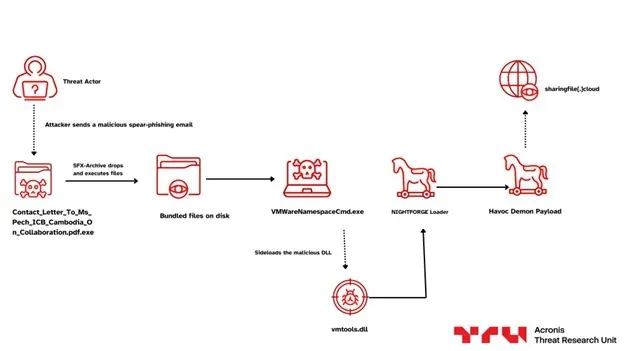
Khmer Shadow targets Cambodian government: A new cyber-espionage group is behind spear-phishing campaigns seeking to infect members of the Cambodian government. Two separate campaigns have targeted the country's defense and public works sectors. The attacks are deploying a new malware strain named NightForce. Evidence suggests the group may be a Chinese APT but no formal attribution has been made. [Acronis]
OpenAI takes down Chinese info-op: Chinese hackers used ChatGPT to automate two influence operations targeting the American public and tech sector. The campaigns sought to undermine the US' push to build AI data centers, the supremacy of American AI companies, and Donald Trump's tariffs strategy. The two clusters used ChatGPT to generate social media comments and images, and specifically told the AI agent not to include Chinese leader Xi Jinping in the output. [OpenAI]

Vulnerabilities, security research, and bug bounty
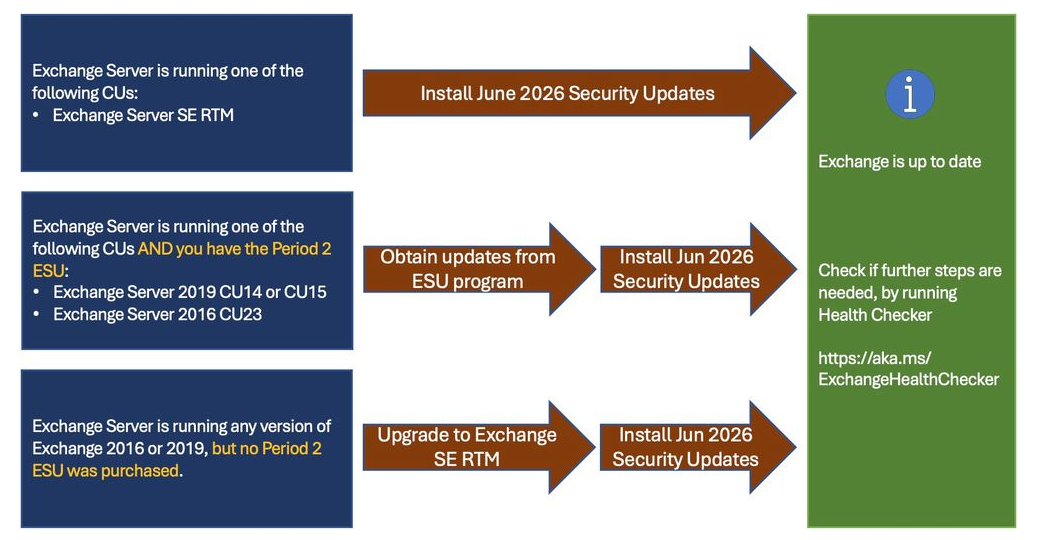
Microsoft Exchange zero-day: Microsoft has released a security update to patch an Exchange zero-day that was abused in the wild. The zero-day allows attackers to run malicious JavaScript code in Exchange inboxes under certain conditions. Microsoft first disclosed the attacks in May and released a temporary mitigation. It released a full security update on Tuesday. [Microsoft // CVE-2026-42897]
ShinyHunters deploys new Oracle zero-day: The ShinyHunters hacking group is using a zero-day to hack Oracle PeopleTools ERP platforms and steal sensitive data. The zero-day can allow unauthenticated remote attackers to run code and take over the platform. Attacks have been going on since at least the end of May. Oracle released an out-of-band security update on Wednesday to patch the issue. [CVE-2026-35273 // Google]
Invanti Sentry RCE exploited in the wild hours after detailed write-up: Hackers are exploiting a new pre-authentication remote code execution bug to take over Ivanti Sentry mobile gateways. The bug was patched on Tuesday. Attacks began on Thursday, hours after a detailed write-up went live. Ivanti Sentry was previously known as MobileIron Sentry. [WatchTowr Labs // CVE-2026-10520 // CISA]
phpBB patches major session hijacking bug: Developers of the phpBB forum software have released a security update last week to patch a major vulnerability that can allow threat actors to hijack any users' session. The bug impacts all phpBB versions released over the past decade. Forums are vulnerable in their default setup if OAuth authentication is enabled. [Aikido Security // phpBB]
Time4Popcorn vulnerability: Popcorn Time clone Time4Popcorn has patched a bug that could have allowed attackers to deploy malicious updates to user clients. [Eye Security]
MSSQL AI abuse: Security researchers have abused the new AI feature in MSSQL 2025 to steal the database's own data. [SpecterOps]
Security updates: Jenkins, Oracle, Palo Alto Networks, phpBB, Time4Popcorn.
Infosec industry
Threat/trend reports: Bitdefender, Cobalt, EclecticIQ, Flashpoint, Halcyon, ISC2, OpenSourceMalware, and Zero Networks have recently published reports and summaries covering various threats and infosec industry trends.
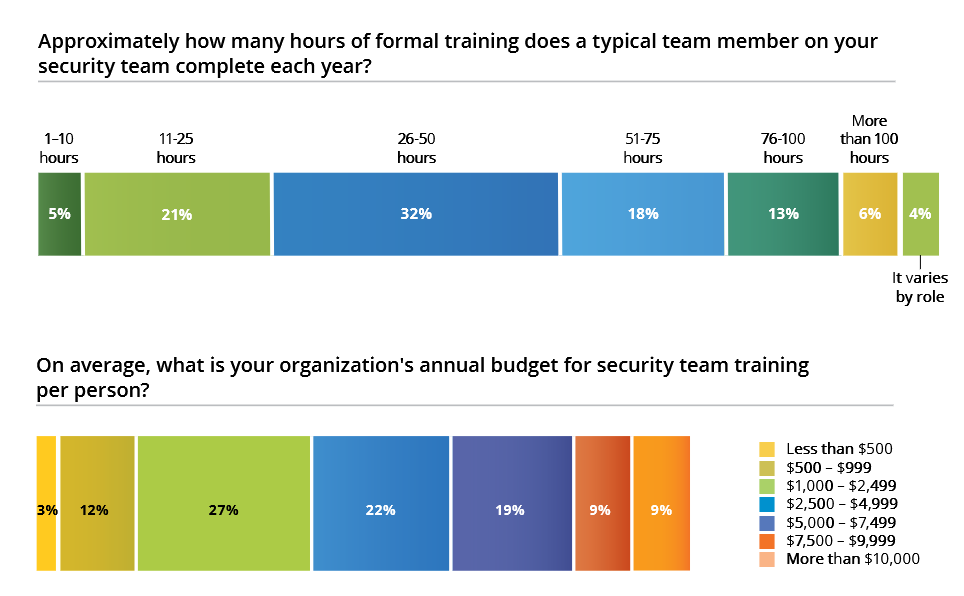
NIST releases ransomware guide: US NIST NCCOE has released a guide to reduce risk and improve resilience against ransomware attacks. [NIST]
New tool—EDRChocker: Red teamer Two Seven One Three has released EDRChoker, a tool to throttle an EDR's bandwidth and time them out.
New tool—OpenRL: Google has open-sourced OpenRL, a self-hosted post-training API for fine-tuning LLMs.
Risky Business podcasts
In this edition of Seriously Risky Business, Tom Uren and James Wilson talk about the European Union's digital sovereignty push. A divorce from US tech giants is on the cards, but building sovereign infrastructure and chip capacity will be hard. From an American perspective this is an entirely predictable own-goal.