

Risky Bulletin Newsletter
October 21, 2026
Risky Bulletin: Hacker hijacks 10% of Tor exit nodes
Written by

News Editor
This newsletter is brought to you by Sondera. You can subscribe to an audio version of this newsletter as a podcast by searching for "Risky Business" in your podcatcher or subscribing via this RSS feed. You can also add the Risky Business newsletter as a Preferred Source to your Google search results by going here.
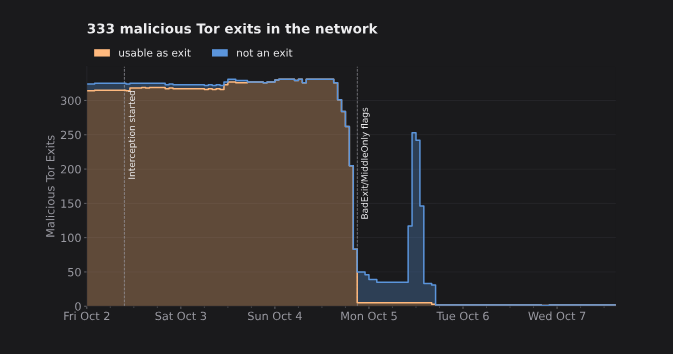
A mysterious threat actor has hacked more than 330 Tor servers earlier this month to carry out a mass-sniffing campaign against Tor users.
The attacker hacked Tor relays, infected them with the Ebury Linux malware, and converted them to exit relays where it could intercept SSH connections and downgrade email connections to steal unencrypted email traffic.
The hacking campaign went undetected for three days, between October 2 and 5, before it was spotted by a Swiss engineer and reported to the Tor security team.
The Tor team notified Tor relay operators about the ongoing hacks. Operators either took down hacked servers or the Tor security team added them to its blocklist, preventing any Tor traffic from passing through.
The hacks are one of the largest security incidents in the Tor network's history, spreading to more than 10% of exit relays before being stopped.
Back in November 2023, the Tor team also removed more than 1,000 Tor servers from its network after they were set up via a for-profit cryptocurrency scheme.
Risky Business Podcasts
In this edition of Between Two Nerds, Tom Uren and The Grugq discuss whether the rise of AI coding will result in more or less bugs and whether it will ultimately make software more secure.
Breaches, hacks, and security incidents
Hacker leaks AfD internal data: A hacker has leaked 281GB of internal data and email inboxes from German far-right political party AfD. The data was taken from the party's web hosting provider. Besides email inboxes, it also includes website databases and internal private documents. An AfD spokesperson claimed the email inboxes were abandoned and had not been used in years—even if the leak contained email threads from this year. [Bild // Hexane.cc]
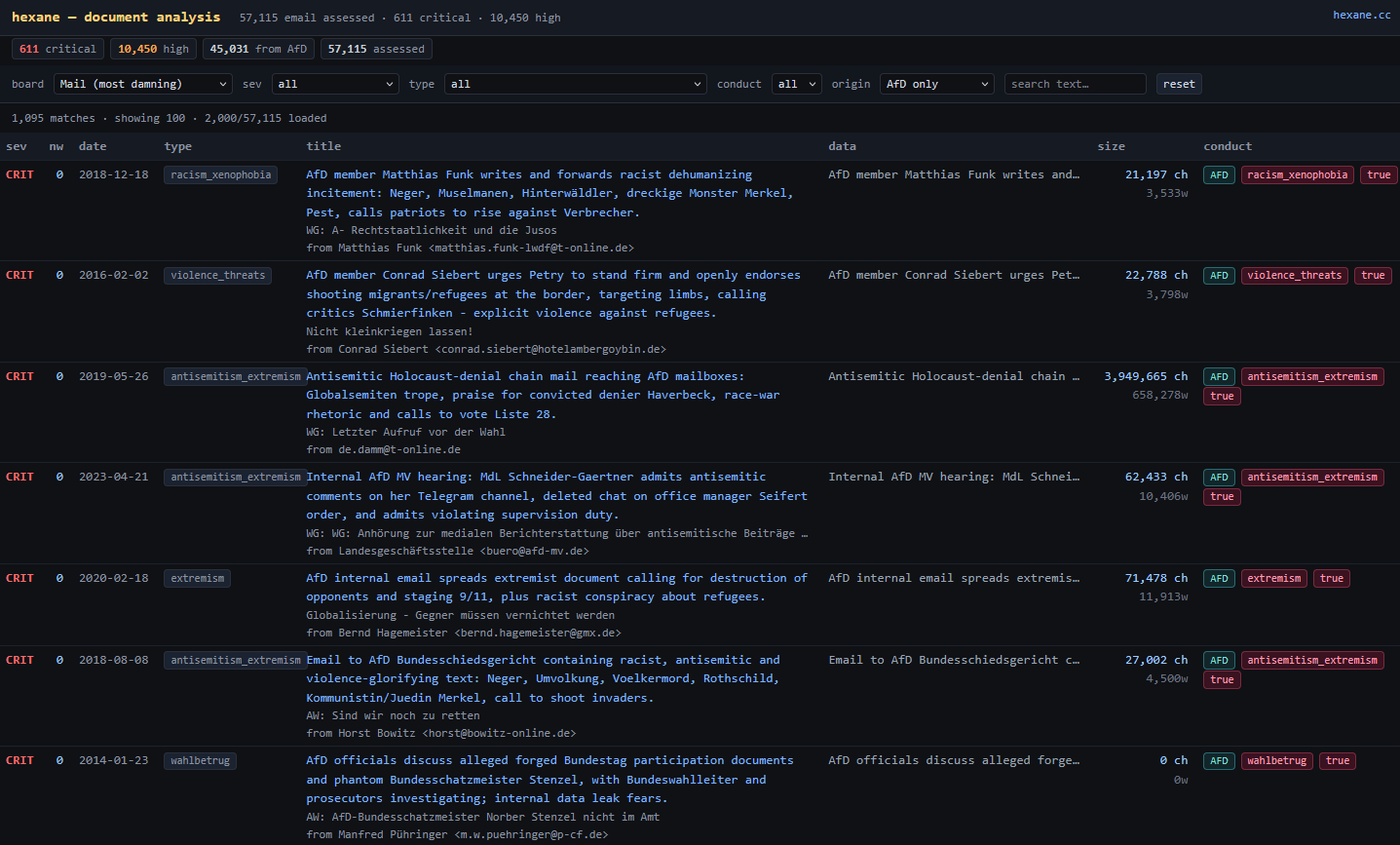
“In email after email, [AfD] supporters use racist slurs and share antisemitic theories of Jewish world domination; there are jokes about turning refugees into handbags and boots, discussions of whether refugees should be shot at the border, a Christmas card sent with a swastika and “Heil Hitler…””
— Michael Colborne (@colborne.bsky.social) October 20, 2026 at 10:09 PM
[image or embed]
Chinese hacker breaches 100+ sites: A suspected Chinese hacker has used AI tools to hack into more than 100 websites. Among the victims are some well known companies like farm equipment maker John Deere, home appliance company SharkNinja, and engine manufacturer Cummins. According to cybersecurity firm NorForge, the hacker used DeepSeek and Claude Code, and the attack cost only $5,000 worth of tokens. [NorForge // Reuters]
Chinese AI agent used in hacks across Japan: An unidentified threat actor has used a Chinese AI agent named Artex to hack at least 20 Japanese companies. Japanese security firm GMO said the attacker focused specifically on Japan. The same agent was also used in attacks against South Korean banks and financial institutions earlier this month. GMO didn't say if it was the same threat actor. [GMO]
Chinese crime ring hacked Staples: A Chinese organized crime group hacked retail giant Staples and issued millions of dollars worth of gift cards. According to 404 Media, the hackers found a way to access an internal Staples app named Nexus. They issued more than 15,000 gift cards worth over $5 million for stores like Target and Sephora. The group used the cards to buy electronics and expensive products, and ship them to China to be sold for a profit. [404 Media]
ICO reprimands two Welsh companies: The UK ICO has reprimanded two Welsh companies for using extremely weak usernames and passwords for their network, with both cases ending up with ransomware attacks and data theft. [UK ICO]
H2O Retailing breach: Japanese retailing giant says hackers stole the data of 1.26 million customers in a breach last week. The breach was caused by unauthorized access to a website operated by Hankyu Hanshin, one of its department store brands. [The Asahi Shimbun]
Cyberattack hits LOXONE home automation company: German smart home and building automation company LOXONE has been hit by hackers over the past weekend. The company was forced to shut down its internal IT network to contain the intrusion. The incident did not spread to customer systems, which run using localized mini-servers. [Archived // LOXONE, PDF]
Nikkei has a third breach: Japanese media conglomerate Nikkei has suffered a third security breach over the past month. The company says hackers used stolen credentials to access a cloud server and steal 1.83 million records. [BreachNews]
Hacker drain $1.4m from Qubic accounts: Crypto platform Qubic halted operations after hackers stole $1.4 million from user accounts. All the affected users were using iOS and macOS. The platform said customers used wallet seed phrases generated with insufficient randomness. Qubic froze around 87% of the stolen funds and is working to restore them to customer wallets. [Blockonomi // Qubic]
Cyberattack cripples Romania's radio comms company: A cyberattack has hit Romania's state-owned company that broadcasts radio and TV signals. The attack has crippled the internal IT network of the National Radiocommunications Company, or Radiocom. The company has shut down its email server following the attack. The radio communications network has not been affected. [SNR on Facebook // Cotidianul]
Ukraine data platform breach: A Russian-speaking threat actor has gained access to an Elasticsearch server and stole 6.8 million documents from Ukraine's state data-exchange platform. [Hunt Intelligence]
Zeabur shuts down after second breach: AI DevOps platform Zeabur will shut down at the end of the year after suffering a second security breach this year. A hacker stole environment variables and other records from more than 320,000 accounts in an incident last week. The company was also hacked in August when a hacker gained access to its AWS backend. [Zeabur]
TeamUpdraft hack: Hackers accessed the backend database of WordPress plugin developer TeamUpdraft in a security incident over the past weekend. The threat actor stole information on customers, their accounts, and connection keys. According to security firm Wordfence, the hackers used the stolen keys to connect to customer sites and deploy malicious plugins. [TeamUpdraft // Wordfence]
Hacker plants malware in OVHCloud app: A hacker has planted malware in the command-line app of French cloud provider OVH. The malicious version was live for less than two hours. OVH CEO Octave Klaba said the hacker got in through one of its developers' GitHub accounts. [OVHCloud on GitHub // Octave Klaba // OpenSourceMalware // The Stack]
Si vous avez téléchargé aujourd'hui la dernière version de CLI d'OVHcloud, merci de la mettre à jour à nouveau très rapidement. Sinon effacer. Il s'agit de repo: https://t.co/mSILpJyTEq La version CLI de 14h47 a été compromise par un hacker. Nous l'avons détecté et bloqué à 16h21. Merci au client qui nous a remonté le souci. La version compromise est v0.11.0 v0.12.0 v0.13.0 v0.14.0 v0.15.0. La version v0.10.0 et la future 0.16.0 est clean. On vient de finit les premières vérifications et aucun autre repo n'est affecté. Nous avons aussi retracé l'incident. Le hacker a utilisé le compte github d'un des développeurs et a ajouté un binaire dont le job est récupérer les secrets sur le disque. La qualité du binaire est médiocre mais il peut aller jusqu'au bout. Si vous êtes concernés, merci de changer tous les secrets sur votre disque. On continue les recherches sur le binaire et on va publier les détails additionnels sous peu.
— Octave Klaba (@olesovhcom) October 19, 2026
General tech and privacy
Meta spy glasses record all conversations: Meta creep glasses had a bug over the past days where they recorded conversations without the owner's consent or a "Hey Meta" prompt. [Android Authority]
Chrome gets ClickFix protections: Google is adding new protections to its Chrome browser to detect and block ClickFix attacks. The new feature works in real-time to detect when users copy suspicious commands. The commands are sent to Google's Safe Browsing service to be processed and if malicious behavior is detected, a warning is shown to the user. [Google]
Privacy Badger comes to Safari/macOS: EFF's Privacy Badger extension is now available for Safari on macOS. [EFF]
Mozilla blacklists eMudhra certs: Mozilla has removed the eMuhdra root certificate from Firefox after eight of the company's intermediary certs had their private keys compromised. According to researchers, the certificates were generated using weak private keys that were mostly zeros apart from the last character. Threat actors forge the private keys and then issue eMuhdra-signed certificates and impersonate legitimate services. Six of the eight are for issuing TLS certificates, while the other two are for code-signing and trusted only by Microsoft. Google is also expected to untrust eMuhdra in a future Chrome update. [Mozilla // Chrome Root Store discussions // Dennis Jackson]
Google Cloud outage: A Google Cloud outage on Tuesday took out banking services across Europe at Revolut, Lloyds, and many more. [Business Insider]
Court sides with NSO Group: A US court has sided with NSO Group and ruled that Meta failed to sufficiently prove that the Israeli spyware maker defied a court order and used its Pegasus spyware to hack new WhatsApp accounts. [The Record]
Government, politics, and policy
Pentagon wants to deploy AI agents on enemies: US Army Cyber Command is developing AI agents that can hack into enemy systems and neutralize their computer systems. According to files obtained by The Intercept, the new program is named ECHOTRIBBLE. The program's AI agents will have to autonomously navigate enemy infrastructure, select and disable targets, and then self-destruct. The Pentagon is looking for potential contractors to build the new system. [The Intercept]
Wyden calls for ECH adoption: US Senator Ron Wyden has urged the US government to adopt Encrypted Client Hello (ECH) for its official websites. [Sen. Wyden]
DHS bans DeepSeek on govt networks: The US Department of Homeland Security has banned the use of Chinese AI model DeepSeek on government networks. The agency has cited risks to national security as government employees may share sensitive data with DeepSeek agents. Chinese laws force Chinese companies to share data with the government on request. [Federal Register, PDF // CyberScoop]
DHS asked CISA to hack a voting machine: DHS officials asked CISA staff last year to acquire and hack a voting machine, report on the findings, and not tell the vendor about the bugs. The staff was supposed to compile a report to be shared with the White House. According to a ProPublica investigation, CISA staff refused because DOGE just fired its red team and because they feared their actions might be used for "political interference" in the election process. [ProPublica]
Moldova probes Yandex: The Moldovan government is investigating Russian tech giant Yandex for collecting the personal data of its citizens and storing it in Russia. The company previously claimed all data is stored on servers in the Netherlands. Yandex is also under investigation in Moldova for tax evasion on more than $7.8 million in revenues. [Radio Free Europe]
Canada could save millions by developing its own OS: A new study argues that Canada could develop its own national operating system to replace Microsoft's Windows and still save millions in the process. This appears to be a typical conclusion for many countries these days, with several testing similar solutions. [The Conversation] [h/t Alex Rudolph]
New Pegasus cases in Serbia: Forensic investigators have found traces of the Pegasus spyware on the devices of two members of Serbia's pro-democracy movement. According to CitizenLab and the SHARE Foundation, Professor Vladan Dokic, Rector of the University of Belgrade, and prosecutor Rade Bajic were hacked with the spyware this year. Professor Dokic was involved in Serbia's student-led anti-government protests, while Bahjic investigated government corruption linked to a Jared Kushner project in Belgrade. Both were infected with zero-click exploits to deploy the spyware. Apple notified both of the hacks this year. [CitizenLab // SHARE Foundation // The News Observer // BalkanInsight]
If the EU is serious about supporting democracy in Serbia, it should also be serious about fighting spyware attacks. Once again NSO company behind democratic targets poses the question of the political agenda it serves and the risks for democracy and security. citizenlab.ca/research/peg...
— Saskia Bricmont (@saskiabricmont.bsky.social) October 19, 2026 at 1:25 PM
[image or embed]
Sponsor section
In this Risky Business sponsor interview, James Wilson chats with Sondera co-founder and CEO, Josh Devon, about how AI agents are highly capable, but they’re not the best rule followers or decision makers.
Arrests, cybercrime, and threat intel
Second ransomware negotiator linked to ShinyHunters: The FBI is investigating a second ransomware negotiator who might have helped the ShinyHunters hacking group extort victims. According to cybersecurity reporter Brian Krebs, the individual is an executive at a well known security firm. They allegedly helped the group operate a now-defunct extortion portal. The FBI detained a ransomware negotiator from Canada earlier this month. [KrebsOnSecurity]
Nigerian hacker sentenced to eight years: A US court has sentenced a Nigerian national to eight years in prison for a hacking and identity fraud scheme. Chukwuemeka Amachukwu hacked tax preparation businesses across the US in 2019 and stole the data of their customers. Together with co-conspirators he filed fraudulent tax returns with the IRS and state tax agencies. The group filed tax returns for $8.4 million and successfully obtained $2.5 million. [DOJ]
New WhatsApp scam: German police warn of a new WhatsApp scam where users are asked to vote in a contest but they are actually being tricked to hand over one-time codes needed to link the account to an attacker's device. [German police]
Telcos targeted with fake tracebacks: Hackers are targeting telcos across the world with a phishing campaign posing as the US Industry Traceback Group (ITG). The emails demand traceback for supposed malicious phone calls but redirect telco employees to a GitHub repository hosting malware. According to a CommsRisk report, the scammers are using telco contact details listed in the US Robocall Mitigation Database to spam malicious requests. [CommsRisk]
More ransomware groups adopt PAN bug: Two more ransomware groups—Settra and Inc—are now using a PAN-OS bug (CVE-2026-0257) to breach networks and deploy their payloads. The bug was patched in June and had been incorporated in attacks by the Qilin group in July. [PAN Unit42]
Malware technical reports
SafePay ransomware: US, German, and UK cyber agencies published a security advisory and technical report on the SafePay ransomware, a group that launched in October of 2024. [CISA]
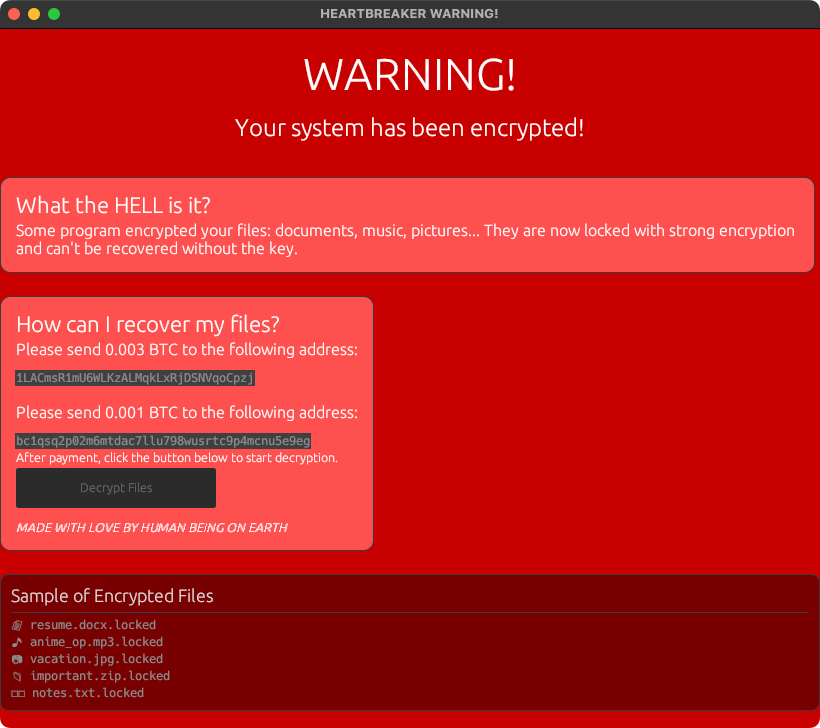
Heartbreaker ransomware targets macOS: Security researchers look at a new macOS ransomware found on VirusTotal. The ransomware seems to be low-effort and can be decrypted. [Objective-See]
Sponsor section
In this edition of the Snake Oilers podcast, Sondera's Josh Devon talks about Sondera technology designed to intervene when AI models start doing the wrong thing by statefully tracking their trajectories. This isn't a permissions suite for AI agents, it's a way to stick agents in a harness and make sure they adhere to hard policy boundaries.
APTs, cyber-espionage, and info-ops
Swallowtail (APT28, Fancy Bear, Forest Blizzard): Good ol' APT28 targeted a law enforcement agency, a naval shipbuilder, and a manufacturer of military aircraft engines in NATO countries. [Broadcom]
Chinese APT uses AI to target Asian governments: Security firm VULONE has uncovered a Chinese group that executed 66 AI-driven intrusions against government and industry targets across Asia. The campaign originated from a single server, reaching 48 systems before the server was exposed online. [VULONE]
BRONZE SANDCASTLE: And speaking of Chinese APTs, Sophos looked at new activity from the BRONZE SANDCASTLE group, with possible targets in Philippines, Taiwan, Afghanistan, Namibia, and South Korea. [Sophos]
Doppelganger targets Israel: Russian disinformation group Doppelganger is targeting Israel in a campaign meant to scare its population. The group has set up infrastructure this year to spread narratives of a war with Turkey and that the US is dropping its military support. The campaign uses Twitter bots and articles impersonating legitimate news outlets. [ClearSky]
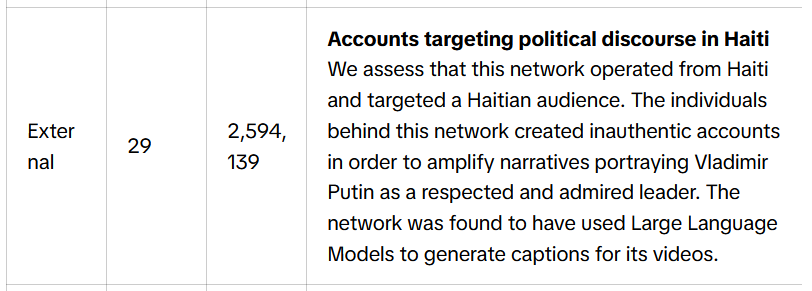
TikTok info-ops summary: TikTok has published its monthly report on covert influence operations the company has spotted on its platform in August this year. The company took down influence networks targeting political discourse in Spain, Peru, Kazakhstan, Colombia, Brazil, Haiti, Romania, France, and the US. Most of it was related to the war in Ukraine, elections, and support for extremist parties. [TikTok]
Vulnerabilities, security research, and bug bounty
Security updates: Advantech, GeoVision, IBM, Siemens.
Plex2Shell vulnerabilities: Hackers started exploiting a vulnerability in the Plex Media Server within a day after public disclosure. The attacks planted crypto-miners and proxy software on Plex installs that were not updated. The attack involved a four-bug exploit chain that bypassed authentication to execute code remotely on Plex systems. [Bored Hacker Blog // Zmain]
PHP RCE leaks: The PHP Foundation will release a security update on Thursday to patch two critical vulnerabilities in the PHP programming language. The two vulnerabilities enable rare remote code execution attacks against PHP servers. Both have received a high CVSS score of 9.2. The PHP team have advanced notice for the bugs after details leaked online on Tuesday. The team will release patches sooner if it sees active exploitation. [PHP // WatchTowr]
Potential new iPhone zero-day: According to a confidential Cellebrite document, the company appears to be in possession of a new iPhone zero-day. [Justin.sh]
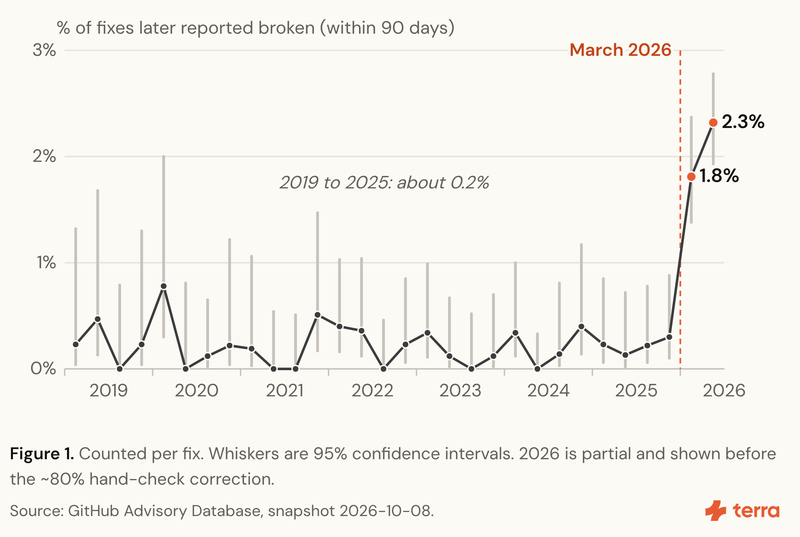
AI patchslop: While everyone focuses on the AI bugpocalypse, Terra Security warns that we're also seeing the rise of patchslop, bugs that are patched by AI agents but break the product or the underlying bugs are still exploitable. [Terra Security]
Infosec industry
Threat/trend reports: BDO, Blockaid, CERT-FR, Contrast Security, Emsisoft, FTC, IBM, KPMG, Point Wild, and Terra Security have recently published reports and summaries covering various emerging threats and industry trends.
New tool—tsrs: Cloudflare has released tsrs, a TypeScript port to Rust.
Risky Business podcasts
In this edition of Seriously Risky Business, Tom Uren and Amberleigh Jack talk about Russian targeting of Ukrainian data centres. That's not good, but it looks like Russia is very poorly prepared for Ukraine's retaliatory strikes. Karma!